

Salt and Pepper Packaging: Products and Formats
Specs as of
The short answer
Salt and pepper packaging here covers products that all share the same formats: stand-up pouches, flat pouches, and sample sachets and stick packs. Because the formats match, you choose by what you pack: salt crystals or flakes, ground or whole pepper, or a seasoning blend, since each behaves differently in a pouch.
What this page covers
- Which section fits a plain or smoked salt?
- Finishing Salt
- Sea Salt
- Himalayan Salt
- Smoked Salt
- Which section fits ground pepper or whole peppercorns?
- Black Pepper
- Peppercorns
- Which section fits a seasoning blend?
- Garlic Salt
- Lemon Pepper
Which section fits a plain or smoked salt?
Sea Salt Packaging, Himalayan Salt Packaging, Finishing Salt Packaging and Smoked Salt Packaging differ in crystal form, from fine grains to hard, coarse crystals and broad flakes, and smoking adds a strong aroma. Pick the section on this page that names your salt.
Salt is hygroscopic: it draws water vapor from humid air, and damp salt clumps. How much vapor passes through a film is measured as its water-vapor transmission rate (WVTR), and a lower number means a better barrier. That rate depends on which films the pouch is built from and how thick each one is, so ask for each pouch's structure from outer layer to inner.
Coarse crystals have hard, angular edges that press against the inner sealant layer, the film that melts under a heat bar to form the seal. Ask about film thickness before you fill a pouch with large crystals.
Which section fits ground pepper or whole peppercorns?
Black Pepper Packaging and Peppercorns Packaging cover pepper, and what sets your pepper apart in a pouch is whether it is ground or whole. Whole peppercorns hold their aromatic oils inside the berry until they are cracked, while ground pepper exposes far more surface to the air, so the pouch's barrier matters more for ground pepper.
Those oils are volatile and fade with exposure to oxygen and light. Oxygen passing through a film is measured as its oxygen transmission rate (OTR). Clear film lets light reach the pepper, while an opaque metal layer in the structure sets how much light passes.
Ground pepper also dusts the inside of the pack as it goes in. Powder caught between the faces being sealed weakens the heat seal, so keep the seal area clean as you fill.
Which section fits a seasoning blend?
Garlic Salt Packaging and Lemon Pepper Packaging cover seasoning blends rather than a single salt or spice. One starts from salt and the other from pepper, and the added ingredients change how the product behaves once it is in the pack.
A blend mixes particles of different size and weight. As a filled pack is moved and shaken, finer particles work down and coarser ones rise, so the top of a pack can taste different from the bottom.
A blend line often runs several flavors, each in its own printed design. Pouch film is printed by flexo, rotogravure or digital: digital prints straight from the file with no plates, which suits short runs and versions, while flexo's coarser screen favors solids and spot colors over fine photographic detail.
Formats


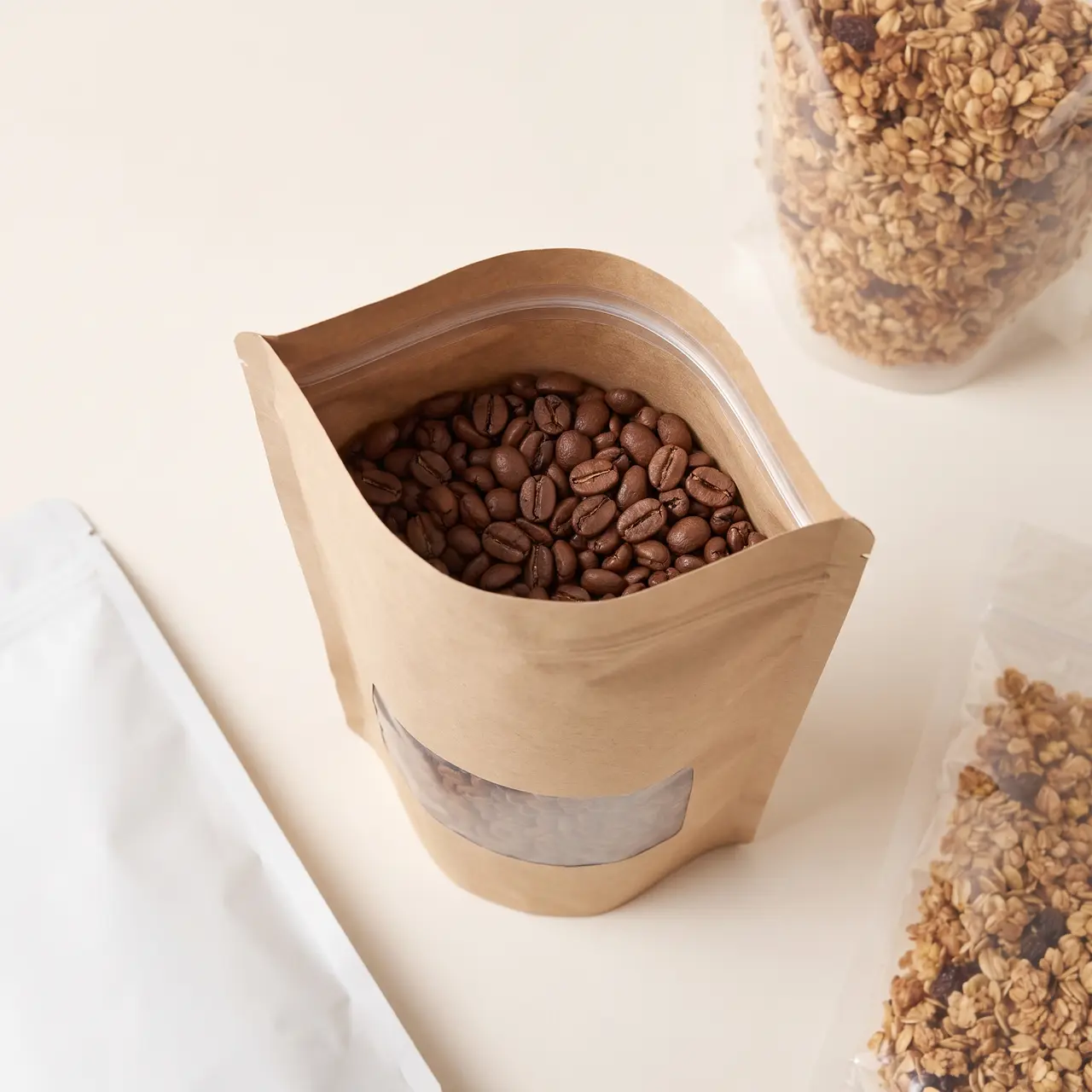
Stand-Up Pouches

Questions
What is the difference between a stand-up pouch and a flat pouch?
When do sample sachets or stick packs make sense for salt and pepper?
Can you tell a foil pouch from a metallized one by looking?
Get your packaging quoted
Tell us the format, size and quantity, and we quote it to your build.